Category: TECHNOLOGY

  • NFTs empowering artists worldwide and its future for everyone

    NFT art is overtaking the world, and the new blockchain technology of NFTs will give artists more strength. NFT art is constantly evolving how artists are compensated and revolutionizing how NFT artists can work, develop unique projects, and claim ownership over their work.

    Non-fungible trinkets, or NFTs, allow artists to record their work on blockchain technology, resulting in a new unique digital asset. NFTs have the potential to decentralize and revitalize wealth while also offering access to various revenue sources. If you’ve ever desired to develop your own PlayStation, film, or even open an art school, NFTs can help you do so.

    According to Visual effects artist Bilali Mack, the propensity to register digital art and logs as innovative has put artists in the direct authority of their own accomplishments. Mack graduated from Emerson College with a B.F.A. in animation and media and soon proved himself as an expert to supervise visual effects and animation space.

    Let’s look at how NFT artists can seize charge of their projects and how NFT art promotes diversity. It’s fascinating because NFTs can contribute to the funding of films and even educational platforms. NFT art can be much more than pricey ape jpegs, and the NFT bubble must burst for the new tech to excel. Below are few examples of how NFT art can be a catalyst for change.

    1- NFT art has the possibility to level the playing field

    “NFTs is such a fine way of levelling up the competitive landscape for people of art, colour, females, and any other community which you can think of that has been disempowered or left out in some way,” Mack says.

    Consider those phrases for a moment. NFT art can facilitate anyone with a story to relate to or a concept to share to do so. You can even create art on blockchains using the finest NFT apps for iPhone. Because of the versatility of NFTs, you can create art, a movie, or a game console for a your group of friends or a large audience.

    2- NFT art will power a huge spectrum of metaverses.

    NFT art does have the potential to facilitate diverse representation, which can lead to a diverse and blends metaverse of storytelling concepts. “Hopefully, that’s the metaverse we want to see, a beautiful universe with a variety of ideas, a diverse range of sites, lots of some really promising projects.”

    NFT provides a vision of the metaverse that we all can all relish, but it also contains a word of caution. Premium manufacturers/brands want in, and thus the possibility of visiting a Nike or Apple store in the metaverse persists. And there is a place for that too, and these brands will necessarily involve artists to develop the assets needed to operate their aspect of the metaverse.

    3- The metaverse necessitates VFX artists.

    NFTs wouldn’t even exist without ILM, John Knoll, and visual effects, as Photoshop was discovered for the film The Abyss, with effects by ILM. It’s a harsh way of describing that today’s VFX artists are now in the finest position to capitalize on NFT art.

    Innovators who can leverage together into a web of influences and skill sets, such as Takashi Murakami’s NFT, which continues to draw on video games, Japanese history, and movies, will flourish in the future of NFTs. As non-fungible trinkets are evolved and new apps are created, it’s convenient for artists with backgrounds and knowledge of 3D modelling, simulation models, AI, and other skills will be in trend; and the VFX industry is a decent training foundation.

    4- NFT artists have the power to claim ownership of their work.

    The future of NFT art is in offering artists authority over their intellectual property rights (IPR) and ownership of their work and projects. But since you don’t have to sell them all at once to a studio, a gallery, an agent, or whoever you’re selling your art to, the rights become much more beneficial to you as an artist.

    Your rights actually become an asset instead of an obligation. NFTs have profited artists like Vakseen by allowing them to reach a broader audience for their work without making compromises with their ownership or rights. In 2021, his wonderful painting of Michael Jordan (above) managed to sell for 8 Ethereum.

    nft art digital art
    Photo by Choong Deng Xiang on Unsplash


  • See how technology’s affect on fertility

    In this article, we are going to discuss how technology affects fertility. Fertility of our life.
    Let get indulge in it!

    The rapid expansion of the Internet, especially exposure to high-speed (broadband) Internet, has characterized the tech transformation that has altered our lifestyles at the turn of the century. Ever since Internet’s commencement, social science studies have emphasized its tremendous impact on social and economic implications.

    Recent studies have initiated examining the Internet’s effects on domestic life, with both terms of day-to-day schedules and long-term impacts. Various points of view and assumptions have progressed. For example, the Internet has been depicted in various ways, including as a revolutionary innovation that affects more traditional family life (Conley 2009), an evolving and conceivably standardized new social arbitrator in the seek for partners (Rosenfeld and Thomas 2012), and a technology that allows spillover effects from work to familial life, but also simultaneously (Wajcman 2015).

    Researchers studying family and fertility have long emphasized the importance of technological progress. The concept of the epidemiological transition established by Boserup (1976) recognizes the critical relevance of (intrinsic) technical advances in population change. Together with significant increases in women’s education and skilled workforce participation (Goldin and Katz 2002), modifications in modern contraception technology have been perceived as a prerequisite for the huge breeding changes that occur in elevated societies during the last decade of the twentieth century, known as the Second Demographic Transition (Lesthaeghe 2010).

    Is the Internet significant for fertility?

    Comprehensive social science research has examined the factors that influence fertility decisions in low-fertility contexts (Morgan and Taylor 2006; Balbo et al. 2013). The Internet, as a prevalent advancement that affects all aspects of society, is likely to influence several behaviour patterns. So how would the Internet as a whole and broadband, in particular, influence fertility?

    Technology may have an impact on the transformation to marriage and, more broadly, the possibility of locating a companion to become a cooperative parent to a child (Rosenfeld and Thomas 2012). According to Bellou (2015), the Internet may reduce search costs while increasing the rate of alliance offers. The Internet has displaced some traditional modes of partnership formation, including family and school, but it has also swept away some other pathways, such as neighbourhoods, workplaces, and friendship networks (Rosenfeld and Thomas 2012).
    However, the overall impact on marriage and the total indirect influence on fertility may be vague, as a wider pool may boost the likelihood of a match while also increasing the searcher’s preferred reservation reliability in terms of potential collaborators. Technology may also overwhelm time spent with a companion (or looking for a partner), significantly lowering fertility.

    Thus, the Internet’s impact on fertility can be hindered by marriage.

    Conclusion

    After reading this article you all might have got that technology somehow improve fertility.
    In vitro fertilization (IVF), which is still a relatively fresh field, continues to profit from technological advancements. Fertility physicians can now enhance the precision of certain processes thanks to advancements in hardware and microtechnology. In addition, new AI software that can more assertively anticipate the health and achievement of frozen eggs and embryos has been discovered and released. It all depends on one’s perception, how and for what you are taking technology.


    Disclaimer: Please consult a doctor for any health issues, article is just for informative purposes only. Every person has a different body type and expert opinion is always recommended. 

  • How to make your iPhone run faster

    Everyone in the world owns a smart phone today. And more often than not, more than half of the world’s population is probably using an iPhone. We all like to exchange notes on how satisfied or dissatisfied we are with our phones. One of the most common complaints that we hear from iPhone users is how slow their phone has become.

    Over a period of time, loading becomes slow on iPhones and it is not because your phone has become old or that your network is slow.  A simple reason could be that your iPhone has too many useless files and app data which could lead to the fact that your cache needs to be cleared.

    What does cache data have to do with it may be your next thought. And it does have a lot to do with it. Cached data contains all the files and images that your phone has hidden away in its memory. This can be anything from passwords and scripts from previously visited websites that your phone remembers for easy access.

    Theoretically, it is designed to make things easier and faster for you so that your phone does not have to repeatedly ask you for your passwords or other related information. The general view of the tech community is that when your iPhone gets backed up with too much data, your phone’s cache can make your device run at slower speeds. However, this view is yet to be confirmed by Apple.

    A healthy habit to adopt would be to clear your cache to enable your phone to operate at full capacity. Luckily, it is an easy process that even those who are not technologically savvy can do it themselves.

    How to make your iPhone run faster 1

    If you feel that your iPhone is in desperate need of a spring cleaning, follow these steps, starting with the app that you probably use the most, Safari.

    1. Clearing Cache on Safari

    However, a word of caution before you start deleting all your data. Make sure you know your essential passwords as this process will log you out of the websites you frequent.

    a. In “Settings”, find the “Passwords & Accounts” section and tap “Safari”.

    b. After the toggles, you will see “Clear History and Website Data”. Tap on that.

    c. Your device will double check whether you want to clear Safari’s data, so click through the message that follows.

    2. Clearing third-party apps’ cache

    a. When it comes to third part apps that you’ve downloaded like Facebook, Instagram, Twitter, Google Maps etc-you can manage your storage by going to “Settings”. In “Settings” got to “General” and then tap on “iPhone Storage”

    b. In “iPhone Storage”, you will see a list of your apps, the top ones indicate that they hold the most data.

    c. By tapping any of these apps, you will see exactly how much space their “Documents & Data” is taking up.

    d. If your device is becoming full, it will offer recommendations as to what to clean up on the “iPhone Storage” page. Tap the “Show All” button to read the descriptions for each.

    e. If you would like to take any of the recommendations, tap “Enable”.

    6. But if you would rather clear out space manually, go into the app and start clearing out unnecessary files, such as old text conversations, playlists, pictures, e-mails etc.

    3. Deleting and redownloading apps to clear cache

    If there is one particular app that is taking a lot of space, then it would be worthwhile to delete the app and download it again. This is because your social apps are storing not just passwords, but images and videos that you have already watched. Sometimes the only way to clear that cache is to erase it and clear out a significant portion of its cached data.


  • Lend Your Eyes To A Blind Person Through This Be My Eyes App

    Yes, there is an app that allows strangers to volunteer to be the eyes for blind people. It is a free app called ‘Be My Eyes’ and it connects blind people with volunteers who can see. Through a live video call, the blind person and the volunteer can communicate directly and solve a problem. This way, ‘sighted volunteers lend their eyes to solve tasks big and small to help blind and low-vision people lead more independent lives’.

    Be My Eyes

    Isn’t it just wonderful when technology is used for such selfless noble acts of service?

    How the app works

    Lend Your Eyes To A Blind Person Through This Be My Eyes App

    When a blind or a partially sighted person requests help on the app, a notification is sent to several volunteers. The volunteer who responds first to the request is connected to that person. Then, through a live video call between the blind person and the volunteer, the assistance is provided – checking expiry dates on products, navigating places, reading instructions, differentiating between colors, reading a street sign, etc.

    Be My Eyes was founded in Denmark by Hans Jørgen Wiberg, who is visually impaired himself. Through his work for the Danish Association of the Blind, he got the idea of using video technology for sighted assistance combined with a network of sighted volunteers. More than 1.8 million volunteers comprise the global network of the Be My Eyes app. They are able to assist in more than 180 languages and are available whenever you want and as often as you need. Be My Eyes is great for reading labels on food items, organizing belongings, finding lost items and even trickier tasks like navigating through a new place or choosing an outfit to wear.

    They are able to assist in more than 180 languages and are available whenever you want and as often as you need.

    Here are some sighted volunteers on a Reddit post, talking about the app and how they enjoy being volunteers on it –

    “I personally have been called on to help someone choose the right color sweater, adjust the thermostat accordingly, and help determine who sent a package. All wonderful experiences with people I wouldn’t have connected with otherwise!”

    “I have had this app for MONTHS and I have gotten two calls, and both were pleasant and wonderful experiences. One was checking the expiry on a cold medication bottle and the other was checking to see if they had a certain spice.”

    “I’ve helped someone identify a poster they got in the mail (and got a lesson about a foreign rock star, very cool!), find the right can of soup, resume a show on Netflix, and choose a beer! I love this app.”

    “I was asked to help set a washing machine on the right cycle and say how many diapers were in a package. I think it’s a fantastic service and I’m happy to be of help!”

    “I helped someone with their medication, money, thermostat and….reverb settings on an electric keyboard. I expected the first three and was very glad to help. The last one was a total surprise but awesome. The guy was in the best mood, found the reverb he wanted and needed to remember the settings. What a great app!”

    Lend Your Eyes To A Blind Person Through This Be My Eyes App 1

    Install the Be My Eyes app on your phone and be a volunteer! Help Be My Eyes in reaching their goal to ‘make the world more accessible to people who are blind or have a low level of vision’.


    Images: Be My Eyes Press Kit

  • Somnox Sleep Robot will help you sleep faster and feel relaxed

    The lifestyle we all living getting peaceful sleep is also a challenge. Many of us are suffering from insomnia. The stressful life and so many things to do makes us so restless that we are not able to even sleep properly.

    To fight is a big issue here is a company that has built a robot called Somnox Sleep Robot. This handy robot will help you sleep faster, longer and wake up refreshed by slowing down your breathing, focussing your attention and playing soothing sounds.

     Somnox Sleep Robot

    The products come from a company based in the Netherlands where technology is innovating. The prototype Somnox was made at the Delft University of Technology in 2015.

    You must be wondering how can a robot slow down your breathing.

    Somnox Sleep Robot simulates breathing rhythms.

    Because your breathing naturally adjusts to another breathing pattern, the Sleep Robot is able to slow down your breathing. This makes you relax, making it easier to sleep.

    The proprietary technology inside the Somnox Sleep Robot includes multiple sensors, including a CO2 sensor to sense breathing, an accelerometer to detect movement and an intelligent algorithm to soothe the user to sleep. Users snuggle with the Somnox Sleep Robot and subconsciously replicate the breathing rhythm of the soft robot. Research has shown that breathing is essential to naturally reduce stress and increase relaxation.

    The Sleep Robot has been designed to be a comfy, useful, and easy to use the product. Affection is mainly ensured by the ergonomic shape of the robot and the material used to cover it. The Sleep Robots’ shape is designed to allow the sleepers to comfortably place it on their chest, wrap their arms around it and hug it. In this way, the Sleep Robot is able to give you affection.

    The Sleep Robot has been designed to be a comfy, useful, and easy to use the product. Affection is mainly ensured by the ergonomic shape of the robot and the material used to cover it. The Sleep Robots’ shape is designed to allow the sleepers to comfortably place it on their chest, wrap their arms around it and hug it. In this way, the Sleep Robot is able to give you affection.

    Soothing sounds such as heartbeats, lullabies, white noise and guided meditation are included in the accompanying app, which is available on both iPhone and Android smartphones.

    If you are worried that too much technology is harmful and at least in the bedroom. Well, we should be worried more about the use of mobile and laptop which require your attention and eventually you are not relaxed.

    People who are looking for a non-medical option for their cure of lack of sleep. Then this option is worth giving a try. This tiny robot won’t hurt you.

    Here is a video you see how it works.


  • What would it take to build a tower as high as outer space?

    The human desire to create ever bigger and more impressive structures is insatiable. The pyramids of Ancient Egypt, the Great Wall of China and the Burj Khalifa in Dubai – now the tallest edifice in the world at over 828 metres (2,722 ft) – are a consequence of pushing engineering to its limits. But huge buildings aren’t just monuments to human ambition: they might also hold the key to humanity’s progress in the space-faring age.

    Proposals are now circulating for a free-standing tower or ‘space elevator’ that could reach up into the geosynchronous orbit around the Earth. Such a tower would be an alternative to rocket-based transport, and drastically reduce the amount of energy it takes to get into space. Beyond that, we can imagine space-based megastructures many kilometres in size, powered by solar energy, perhaps encompassing whole planets or even stars.

    In recent years, engineers have been able to build on grander scales thanks to the strength and reliability of substances such as novel steel alloys. But as we enter the realm of megastructures – those of 1,000 km or more in dimension – maintaining safety and structural integrity has become a fiendish challenge. That’s because the bigger something becomes, the more stress it experiences due to its weight and size. (‘Stress’ is a measure of mechanical tension, like when you pull something apart from either end, or squeeze it together. ‘Strength’ is the maximum tension a structure can withstand before it breaks.)

    It turns out that biological design, equipped with around 3.8 billion years of experience, might help solve this puzzle. Before the age of materials science, engineers had to look to nature for creative tricks to help them overcome the restrictions of their materials. Classical civilisations, for example, souped their war machines with twisted tendons made from animal hides, which could extend and snap back to launch projectiles at the enemy. But then substances such as steel and concrete arrived, and became successively tougher and lighter.

    This led to a sub-discipline known as ‘reliability engineering’. Designers started to make structures that were much stronger than the maximum possible load they needed to bear – which meant the stress on the materials stayed within a range where the probability of breakage was very low. Once structures turn into megastructures, though, calculations show that this risk-averse approach places a cap on their size. Megastructures necessarily push materials to their limits, and remove the luxury of weathering comfortable levels of stress.

    What would it take to build a tower as high as outer space
    Photo by Daniel Chen

    However, neither the bones nor tendons in our bodies enjoy this luxury. In fact, they’re often compressed and stretched well beyond the point at which their underlying substances might be expected to break. Yet these components of human bodies are still much more ‘reliable’ than their sheer material strength would suggest. For example, merely running can push the Achilles’ tendon to over 75 per cent of its ultimate tensile strength, whereas weightlifters can experience stresses of over 90 per cent of the strength of their lumbar spines, when they are hefting hundreds of kilogrammes.

    How does biology handle these loads? The answer is that our bodies constantly repair and recycle their materials. In tendons, collagen fibres are replaced in such a way that, while some are damaged, the overall tendon is safe. This constant self-repair is efficient and inexpensive, and can change based on the load. Indeed, all structures and cells in our bodies are in constant turnover; it’s estimated that almost 98 per cent of the atoms in the human body are replaced every year.

    We recently applied this self-repair paradigm to see whether it’s possible to build a reliable space elevator with available materials. A common proposed design features a 91,000 km-long cable (called a tether), extending out from the Equator and balanced by a counterweight in space. The tether would consist of bundles of parallel fibres, similar to collagen fibres in tendons or osteons in bones, but made from Kevlar, a material found in bullet-proof and knife-proof vests. Using sensors and artificially intelligent software, it would be possible to model the whole tether mathematically so as to predict when, where and how the fibres would break. And when they did, speedy robotic climbers patrolling up and down the tether would replace them, adjusting the rate of maintenance and repair as needed – mimicking the sensitivity of biological processes. Despite operating at very high stress compared to what materials can sustain, we showed this structure would be reliable and would not demand exorbitant rates of replacement. Moreover, the maximum strength the material would need to possess to achieve a dependable structure was cut by an impressive 44 per cent.

    This bio-inspired approach to engineering can also help structures down here on Earth, such as bridges and skyscrapers. By ‘challenging’ our materials, and equipping systems with autonomous repair and replacement mechanisms, we can exceed current limitations while improving reliability. To get a sense of the benefits of operating closer to the limit of tensile strength, look at a suspension bridge, involving lengths of steel rope that dip in the middle. The main hurdle to increasing the span of the bridge is that, as we use longer ropes, they become heavier and break under their own weight. If the rope is stretched to no more than 50 per cent of its total strength, the maximum span is about 4 km; but when stretched up to 90 per cent of its strength, the span dramatically increases to more than 7.5 km. However, ensuring the cable is safe will require steel fibres to be replaced in a fine-tuned process, just like in biological systems.

    Megastructures are no longer science fiction. Never dissuaded by the collapse of the Tower of Babel, as recounted in the Old Testament, humans have continued to build bigger and higher and faster, fuelled by tremendous advances in science and technology. Yet according to the standards of classical reliability engineering, we are still far away. Instead we need a new paradigm, one that focuses not only on material strength, but on systems’ inherent reconstructive capacities. We ought to look no further than the bounty of biological life around us and trust there is much to learn from the sweep of evolutionary history.Aeon counter – do not remove

    Sean Sun & Dan Popescu

    This article was originally published at Aeon and has been republished under Creative Commons.


  • Internet Hacker Breaks Into Routers To Save Them From Other Hackers

    So there’s a Russian grey-hat hacker who breaks into people’s routers from MicroTik and patches them. He goes into the routers and makes changes in their settings so that they will not be battered by those big cyber bullies and criminals out there in the digital world!

    This internet vigilante who hacks into routers to save them from other hackers goes by the name “Alexey”.

    He claims to have patched more than 100,000 routers already! He prides his work, which seems to be a dear hobby of his, on a Russian blogging platform and mentions that he merely adds some firewalls rules which are used to block any access to every router from anywhere outside of the local network. “In the comments, I wrote information about the vulnerability and left the address of the @router_os Telegram channel, where it was possible for them to ask questions”, Alexey added.

    This vulnerability of MikroTik routers came to light in late April this year, and the company rolled out a patch for it in no time. However, black-hat hackers still took pleasure in taking advantage of the bug as much as they could. This bug was effective especially because cybercriminals could easily get a user’s database file, where all the usernames and passwords are stored. They could then create chaos anywhere they pleased, and no one would be get to know about it. This is some serious cybercrime!

    It is surprising that out of the 100,000 routers that Alexey has patched, only 50 users reached out to him via Telegram. Just a few of them displayed their gratitude towards Alexey for patching their routers, while most of the people who have been hacked by him are nothing but irritated with him and want nothing to do with him.

    Security researcher, Troy Mursch, says that over 420,000 MikroTik routers currently connected to the internet show signs of being infected with cryptocurrency-mining scripts. MikroTik has made the patches available on the internet but it is actually up to the users to make the updates and keep themselves protected.

    According to Alexey, the cybercriminals are not subtle or unnoticeable in their work, and that is why he has been able to fix a large number of routers. He is doing what he can to help people in the digital world. Though despite his good intentions of helping people stay protected, Alexey is on the wrong side of things. It is illegal to access another person’s information without consent.

    An Internet Hacker Breaks Into Routers To Save Them From Other Hackers
    Photo by Greg Weaver

    Story Credit 


  • Tired of boring walls. Lets make them interactive with Scribit

    You would agree that wall sticker are becoming boring and so out dated. Even to put those sticker on wall sometime is messy job and if its not neatly done its just waste of time.

    We want our office or home to be liking of our interesting and theme. Professional services is available but its expensive and not all are good. In the age of automation and robots, there something good should out there in the market.

    What if you could instantly turn your office or living room wall into a canvas for digital content, and update it in real time?

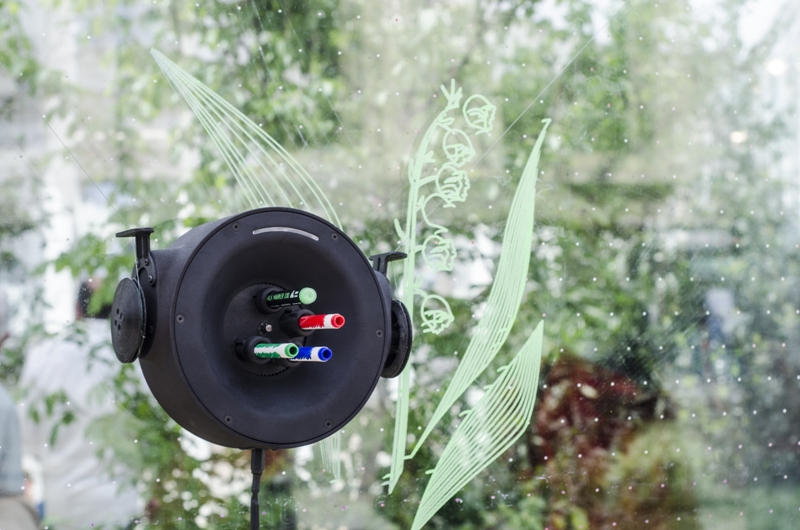
    Carlo Ratti Associati unveils Scribit, an intelligent ‘writing robot’ that allows you to draw images and text on any wall surface.

    Carlo Ratti Associati unveils Scribit, an intelligent ‘writing robot’ that allows you to draw images and text on any wall surface.

    Any surface means that this writing robot can draw images or text on surface like whiteboards, glass or standard plaster. Thus, any vertical surface can be transformed into a screen – a wonder wall where images, messages, or feeds are projected. Scribit can safely draw, erase and re-draw new content an infinite number of times, allowing you to print a different image on your wall every few minutes.

    Scribit can safely draw, erase and re-draw new content an infinite number of times

    Scribit is always connected to the web, meaning that you can download, upload or source any content from the Internet. A restaurant can post the day’s menu on its wall, a financial firm can post stock market updates in its lobby, or someone who loves art can project a Van Gogh or their own drawings – onto their bedroom wall. Scribit’s interactive software allows the real-time reproduction of any kind of data, including notes, messages, pictures, and graphics. Once the user sends their digital information to the device, the plotter immediately reproduces it.

    Tired of boring walls. Lets make them interactive with Scribit 1

    Scribit works on a two-axis plane, moving up and down two very light cables hanging off a vertical wall. It can place itself at any point with great precision and uses markers to reproduce any type of content. The devices uses four primary color combination to produce the images you want.

    Scribit can safely draw, erase and re-draw new content an infinite number of times

    This device work through an App, which offer users access to a broad range of digital content. What an idea that Scribit can safely draw, erase and re-draw new content an infinite number of times. The installation just takes 5 minutes, all you nneed two nails and one power plug, ready to go. It is envisages in future to integrate Scribit robot with AI based systems like Alexa, Siri and Google.

    scribit drawing

    The company plans to deliver Scribit by December 2018.


    Credit : CRA-Carlo Ratti Associati


  • Humanoid Robots becoming unimaginably realistic

    As our civilization advances continuously toward automation and building machines,we are seeing changes happening right before our eyes. We shouldn’t be surprised if in the next decade we have robots in our homes. The companies that are building these robots are foreseeing that these robots will help us and make our lives easy but only time will tell. For now the pace at which these things are advancing, is just like a dream.

    Each company is building their own style of artificial intelligence (AI) infused robots which are capable of taking their own decisions and surprisingly these robots look like humans and not  piece of some hardware. The close resembles to human is quite shocking that some perceive it as the beginning of the end for humans.

    Lets see some of these humanoid robots which are unimaginably realistic

    1. Miiim or HRP-4C: She is looks like an average young Japanese woman. She can move like a human, utilizing 30 body motors and another eight dedicated to facial expressions. She even has some vocal capabilities like singing.

    HRP-4C miim
    Via

    Check out the video and decide for yourself, its realistic or not


    2. Sophia : She has been making headlines recently. She is a humanoid robot developed by a Hong Kong based Company called Hanson Robotics. She is capable of displaying more than 50 facial expression and have answer to most of the questions. She even did an interaction with actor Will Smith which you can check here.

    sophia robot
    Via

    In 2016, she became a citizen of Saudi Arabia and she is the first robot to have received a citizenship .


    3. The News Reader ‘Kodomoroid and Otonaroid’:  People who are news readers, beware! They  humanoid robots are coming to take your jobs. Both Kodomoroid and Otonaroid can perform simple tasks like reading news and has some facial expression. They work at Tokyo’s National Museum of Emerging Science and Innovation.


    4. Jia Jia: She is also called Robot Goddess. She hails from China and built by University of Science and Technology in China. She is capable of performing various facial expression.

    jia jia robot
    Via


    5. Yangyang: This humanoid robot is jointly developed by China’s Shanghai Yangyang Intelligent Robot Science Service center and Japanese professor Hiroshi Ishiguro. She can do facial expressions and a variety of gestures.

    This humanoid robot is jointly developed by China’s Shanghai Yangyang Intelligent Robot Science Service center and Japanese professor Hiroshi Ishiguro. She can do facial expressions and a variety of gestures


  • In order for Robots to be smart they need both think and feel

    For more than two millennia, Western thinkers have separated emotion from cognition – emotion being the poorer sibling of the two. Cognition helps to explain the nature of space-time and sends humans to the Moon. Emotion might save the lioness in the savannah, but it also makes humans act irrationally with disconcerting frequency.

    In the quest to create intelligent robots, designers tend to focus on purely rational, cognitive capacities. It’s tempting to disregard emotion entirely, or include only as much as necessary. But without emotion to help determine the personal significance of objects and actions, I doubt that true intelligence can exist – not the kind that beats human opponents at chess or the game of Go, but the sort of smarts that we humans recognise as such. Although we can refer to certain behaviours as either ‘emotional’ or ‘cognitive’, this is really a linguistic short-cut. The two can’t be teased apart.

    What counts as sophisticated, intelligent behaviour in the first place? Consider a crew of robots on a mission to Mars. To act intelligently, the robots can’t just scuttle about taking pictures of the environment and collecting dirt and mineral samples. They’d need to be able to figure out how to reach a target destination, and come up with alternative tactics if the most direct path is blocked. If pressed for time, the team of robots would have to know which materials are more important and to be prioritised as part of the expedition.

    Part of being intelligent, then, is about the ability to function autonomously in various conditions and environments. Emotion is helpful here because it allows an agent to piece together the most significant kinds of information. For example, emotion can instil a sense of urgency in actions and decisions. Imagine crossing a patch of desert in an unreliable car, during the hottest hours of the day. If the vehicle breaks down, what you need is a quick fix to get you to the next town, not a more permanent solution that might be perfect but could take many hours to complete in the beating sun. In real-world scenarios, a ‘good’ outcome is often all that’s required, but without the external pressure of perceiving a ‘stressful’ situation, an android might take too long trying to find the optimal solution.

    Most proposals for emotion in robots involve the addition of a separate ‘emotion module’ – some sort of bolted-on affective architecture that can influence other abilities such as perception and cognition. The idea would be to give the agent access to an enriched set of properties, such as the urgency of an action or the meaning of facial expressions. These properties could help to determine issues such as which visual objects should be processed first, what memories should be recollected, and which decisions will lead to better outcomes.

    But research from the behavioural and brain sciences suggests that emotion is not just an ‘added feature’ layered on top of ‘standard’ cognition. Instead, it’s an integral part of our cognitive machinery. In one of the experiments from my lab, people in a scanner watched videos of rapid, flashed-up images of either a house or a skyscraper. They had to identify which of these scenes was present in the video, a task designed to be very difficult. We then introduced an element of emotional manipulation. Before viewing the clips, half of the participants received a mild electric shock while viewing a series of skyscrapers; the other half, instead, watched a series of houses appear, paired with the same mild shock. This is what’s known as classical conditioning, and links an initially neutral stimulus (a nondescript picture) with the emotional meaning of the unpleasant stimulus (the shock).

    Robots to be smart they need both think and feel
    Via: Pixabay

    The outcome: participants conditioned to the skyscrapers were better at detecting them than at detecting houses; conversely, participants conditioned to houses detected those better than they did skyscrapers. And in each case, responses in the visual cortex were stronger for the type of stimulus (house or skyscraper) to which participants had been conditioned. This study shows that perception artiis not a passive process that merely reflects the external world. Rather, it involves picking up on the significance of objects, and determines how they are processed. Vision is never neutral, it is always laden with affective meaning.

    It’s the architecture of the brain, with its short- and long-range connections, that allows these properties to emerge. Emotion doesn’t come about from local computations in a single region, such as the amygdala, which is frequently called the ‘emotion centre’ in the brain. Instead, anatomical studies have revealed that the areas in the brain associated with perception, cognition, emotion, motivation, action and bodily sensations are closely intertwined. Looking at the brain as a complex network helps to clarify why some brain structures, such as the amygdala, are important for emotion: they’re hubs, much like major airports that link to a very large number of destinations. As a consequence, these regions can influence and be influenced by many parts of the brain – which also suggests that it’s not possible to subtract emotion without affecting cognition.

    The point is not that emotion is needed for intelligent, autonomous robots – the answer is yes – but that emotion needs to be hooked up to everything that goes on in a cognitive system. Emotion is not an ‘add-on’ module that endows a robot with feelings or allows it to express an internal state, such as the current risk of overheating. Its integration is a design principle of the information-processing architecture. Without emotion, no being that we might create can have any hope of aspiring to true intelligence.

    Luiz Pessoa

    This article was originally published at Aeon and has been republished under Creative Commons.