Category: SCIENCE

  • Breaking the Cycle: How Overthinking Sabotages Productivity and Possible Ways to Overcome It

    Overthinking refers to the process of continuously dwelling on thoughts, ideas, or problems without reaching any resolution. It involves excessively analyzing situations, often leading to a state of mental exhaustion and indecision. Overthinking can manifest in various ways, such as worrying excessively about the future, ruminating on past events, or overanalyzing present circumstances. It can interfere with decision-making, productivity, and overall well-being. Overthinking can waste your time in several ways:

    Analysis Paralysis: Overthinkers often get stuck in a loop of analyzing every possible outcome or scenario, which can prevent them from making decisions in a timely manner. This indecision leads to wasted time and missed opportunities.

    Ruminating on Past Events: Overthinkers tend to dwell on past mistakes or regrets, replaying scenarios in their minds and imagining alternative outcomes. This rumination consumes mental energy and time that could be better spent on productive activities.

    Worrying about the Future: Similarly, overthinkers may spend excessive time worrying about hypothetical future events, trying to anticipate every possible problem or obstacle. This preoccupation with the future can distract from the present moment and prevent effective action.

    Perfectionism: Overthinkers often strive for perfection in everything they do, which can lead to spending unnecessary time on tasks or projects trying to achieve an unattainable standard. This perfectionism can be paralyzing and ultimately counterproductive.

    Lack of Focus: Overthinking can scatter your focus, causing you to jump from one idea to another without making meaningful progress on any single task. This lack of focus can result in inefficiency and wasted time.

    Overanalyzing Social Interactions: Overthinkers may dissect every social interaction, obsessing over what they said or how others perceived them. This hyper-awareness can lead to self-doubt and insecurity, ultimately wasting time that could be spent on more fulfilling activities.

    Stress and Burnout: Constantly overthinking can lead to increased stress levels and eventual burnout, further reducing productivity and wasting time in the long run as you struggle to regain your mental energy and motivation.

    Overall, overthinking can be a significant time sink, draining your mental resources and preventing you from effectively focusing on the tasks and goals that matter most. Learning to manage and redirect your thoughts can help you break free from the cycle of overthinking and reclaim your time for more meaningful pursuits.

    To overcome overthinking, consider implementing the following strategies:

    1. Awareness: Recognize when you are overthinking. Pay attention to the signs, such as repetitive thoughts, indecision, or excessive worry.
    2. Challenge Negative Thoughts: Question the validity of your thoughts. Ask yourself if there is evidence to support them or if they are simply assumptions or irrational fears.
    3. Practice Mindfulness: Focus on the present moment through mindfulness meditation or deep breathing exercises. This can help quiet the mind and reduce the tendency to dwell on the past or worry about the future.
    4. Set Limits: Allocate a specific amount of time to think about a problem or decision. Once the time is up, make a choice and take action, rather than continuing to ruminate endlessly.
    5. Shift Focus: Engage in activities that distract your mind from overthinking, such as exercising, spending time with loved ones, or pursuing hobbies.
    6. Problem-Solving Techniques: Break down complex problems into smaller, manageable steps. Create a plan of action and focus on solutions rather than dwelling on the problem itself.
    7. Practice Self-Compassion: Be kind to yourself and recognize that it’s normal to have doubts and uncertainties. Treat yourself with the same understanding and empathy you would offer to a friend.
    8. Limit Information Intake: Avoid overloading yourself with unnecessary information or seeking reassurance excessively. Trust your instincts and make decisions based on the information available to you.
    9. Seek Support: Talk to a trusted friend, family member, or therapist about your overthinking tendencies. Sometimes, sharing your thoughts and feelings can provide perspective and help you gain clarity.
    10. Set Boundaries: Establish boundaries to protect your mental well-being. Learn to say no to overcommitment and prioritize self-care activities that help reduce stress and promote relaxation.

    By practicing these strategies consistently, you can gradually overcome overthinking and cultivate a healthier mindset that fosters productivity and peace of mind.

  • Consciousness: Understanding the Essence of Awareness

    Consciousness is a complex and multifaceted phenomenon that is central to human experience and understanding. It refers to the state of being aware of and able to perceive one’s own existence, sensations, thoughts, and surroundings. However, defining consciousness precisely remains a challenge due to its subjective nature and the various perspectives from which it can be approached.

    One common approach to defining consciousness is through its components:

    1. Subjectivity: Consciousness involves subjective experiences, such as feelings, emotions, and perceptions, which are inherently personal and cannot be directly accessed by others.
    2. Awareness: Consciousness entails the ability to be aware of oneself and one’s environment, including the ability to perceive external stimuli and internal mental states.
    3. Intentionality: Consciousness involves directedness towards objects, events, or mental representations, where one’s attention and focus are purposefully directed.
    4. Unity: Consciousness provides a unified and coherent experience of the world, integrating various sensory inputs, thoughts, and emotions into a single subjective experience.
    5. Continuity: Consciousness is typically experienced as continuous and uninterrupted over time, forming a continuous stream of awareness.

    As for the purpose of consciousness, it remains a topic of philosophical debate. Some perspectives suggest that consciousness evolved as an adaptive mechanism, allowing organisms to perceive and respond to their environment in more sophisticated ways, thereby enhancing survival and reproductive success. Others propose that consciousness may serve functions related to self-awareness, social interaction, problem-solving, and the construction of a coherent sense of self and reality.

    From a philosophical or spiritual standpoint, some argue that consciousness has intrinsic value and significance, providing a basis for subjective experience, moral agency, and existential meaning.

    Ultimately, the nature and purpose of consciousness continue to be explored and debated across various disciplines, including neuroscience, psychology, philosophy, and spirituality.

  • The Possibility of an End to the Universe: Where Might it Lie?

    The concept of the “end of the universe” is a complex one and depends on various theories in cosmology. Here are a few concepts related to the possible “end” of the universe:

    1. The Observable Universe: This is the portion of the universe that we can observe from Earth. It is limited by the distance that light has had time to travel since the Big Bang, approximately 13.8 billion years ago. Beyond this observable horizon, there could be more universe, but we cannot see it due to the finite speed of light.
    2. Cosmic Expansion: The universe is currently undergoing expansion, and the rate of this expansion is accelerating, as suggested by observations of distant galaxies. Depending on the exact nature of this expansion, there are different theories about the ultimate fate of the universe. In some scenarios, the universe could expand indefinitely, with galaxies moving away from each other until they are no longer visible. This scenario doesn’t necessarily imply an “end” in a specific location but rather a continuous stretching and cooling of the cosmos.
    3. Big Crunch or Big Freeze: These are two potential outcomes based on the density and expansion rate of the universe. In a Big Crunch scenario, the expansion of the universe reverses due to gravitational attraction, leading to a collapse. In a Big Freeze scenario, the universe continues to expand indefinitely, leading to a state where all matter and energy are spread out and diluted, resulting in a cold, desolate cosmos.
    4. Multiverse Theories: Some theories suggest that our universe is just one of many in a larger multiverse. In this framework, the concept of an “end” to the universe might not even apply in the traditional sense, as there could be other universes with different physical laws or dimensions.

    It’s important to note that these ideas are based on our current understanding of cosmology, which is still an active area of research. As such, our understanding of the ultimate fate or boundaries of the universe may evolve with time as new evidence is discovered and new theories are developed.

    universe timelapse
    Photo by Casey Horner

  • These 13 deep-sea scary creatures might give you nightmares

    You would be surprised to know that only 5% of the ocean has been explored till now and which leaves 95% of water unexplored. You can imagine what is stored in these undiscovered water territory. Till now also we get to know new species which are available in the depth of oceans.

    The creatures which oceans hold are unimaginable since we are only familiar with popular species like dolphins, whales, sharks, etc.

    Let take a dive in to find out some deep sea scary creatures that might shock you:

    #1. Anglerfish: It is a bony fish named for its characteristic mode of predation, in which a fleshy growth from the fish’s head acts as a lure for other fish. The Anglerfish look like fish who has inbuilt bate system to catch its prey.

    Anglerfish deep sea fish
    Dante Fenolio / Science Photo Library


    #2.  Red-lipped batfish: This fish is mainly known for its bright red lips and found near Cocos Island off the Pacific coast of Costa Rica. As its name is Red-lipped batfish, this fish got a lot of red lipstick, fashion-conscious? but look a bit scary.

    Red-lipped batfish deep sea creature
    Image Credit


    #3. Ribbon Eel: The ribbon eel is a creature bearing a resemblance to a mythical Chinese dragon with a long, thin body and high dorsal fins. It feels a bit nauseating to look at its body movement or rather hypnotic. 

    Ribbon Eel


    #4. Pink Sea-Through Fantasia: Due to its bizarre appearance, the genus has been dubbed the headless chicken fish, headless chicken monster, and the Spanish dancer. This deep-sea creature definitely looks like some monster from an alien movie.

    Pink Sea-Through Fantasia deep sea creature
    Wikimedia Commons


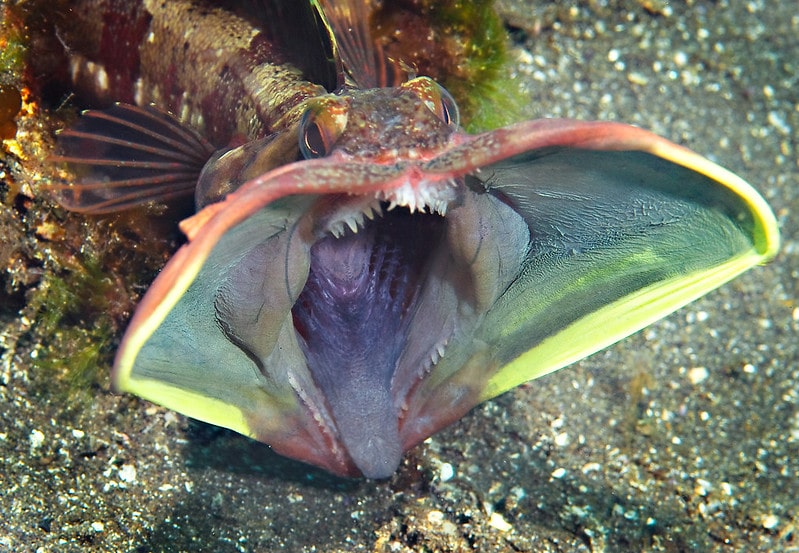
    #5. Sarcastic Fringehead: This is small fish but has a very aggressive behaviour to showcase its dominance on others. They are generally brown in colour. This deep-sea creature looks like Velociraptor (dinosaur).

    Sarcastic Fringehead deep sea creature
    Credit: Adriane Honerbrink


    #6. Barreleye also is known as spook fish: This fishes transparent head makes it scary.

    Barreleye deep sea fish
    Credit: MBARI


    #7. Salp: Another fish that is transparent. The salp strains the pumped water through its internal feeding filters, feeding on phytoplankton. It does a good job but sadly not we would love to feel it.

    Salp deep sea creature
    Image Credit


    #8. Northern Stargazer: Stargazers have a flat forehead with a lot of body mass up front near the mouth. 

    Northern Stargazer deep sea creature
    Image Credit: Wiki


    #9. Goblin Shark: When they are feeding their jaws dramatically extends. This makes it scarier.

    Goblin Shark deep sea creature
    Wikimedia Commons


    #10. Black Dragonfish: This fish is called Idiacanthus atlanticus. It structure is mix of a snake and dragon.

    Black Dragonfish deep sea fish
    GM. Woodward /Wikimedia Commons


    #11. Pelican eel: The pelican eel’s most prominent feature is its large mouth, which is much larger than its body. Pelican eel is found in deep-sea and rarely seen by humans.

    Pelican eel deep sea fish
    Wikimedia Commons


    #12. Chimaera: It is also known informally as ghost sharks, rat fish, spookfish or rabbit fish. Today, they are largely confined to deep water.

    Chimaera deep sea fish
    NOAA Okeanos Explorer Program


    #13. Stareater: The deep-sea creature have delicate skin, and mouths filled with sharp, needlelike, curved teeth.

    Stareater (fish) deep sea fish
    Peter Marriott / Wiki


    Information Source: Wikipedia


    Also see: 5 Exotic Animals That You Can Have As Pets

  • Smart Socks that tracks diabetic health

    Diabetes is recognised as the world’s fastest growing chronic condition among people. Diabetes is termed as a lifestyle disease. According to WHO “the number of people with diabetes has risen from 108 million in 1980 to 422 million in 2014”.

    Diabetes are of two types – Type -1 and Type -2.  Both types of diabetic patients are prone to swelling of feet and hence chances of injury are more. It can lead to serous consequences and if ignored it can even lead to amputation of the foot.

    A startup company “Siren Care” has taken the cause of helping diabetes patients to the next level and invented a smart socks that have sensors which can detect inflammation. This means that the socks can detect any injury in the feet through temperature detection. Temperature increase is a sign of inflammation.

    Siren Care Smart Socks
    ©Siren Care Inc

    The Socks is synced with an App in real time and all information can be accessed through the App. The Siren Care App prompts you when there is a significant temperature increase on the foot so that action can be taken immediately.

    Siren Care Smart Socks
    ©Siren Care Inc
    ©Siren Care Inc
    ©Siren Care Inc

    As the old saying goes “prevention is better than cure”; the founders of the startup company believe that detection sensors in the Sock is the solution for this problem.

    Sensors are woven in the socks for better result since it is closer to the skin. The socks comes with single charge that last up to six months and the socks turns on only when you wear them and goes to sleep when you remove them – this is quite good!.

    Siren Care Smart Socks
    ©Siren Care Inc

    Needless to mention these sock are machine washable and are also available for pre-order.


    Image: ©Siren Care Inc


  • Mind Blowing Facts of Antarctica that are 100% True

    There is no place on Earth more mysterious than Antarctica; its harsh and difficult climate making it hard for a normal person to access the continent. Its icy plains are full of secrets that have been left for humans to discover and because of the vastness of the area, there are places that no human has ever set foot on.

    So, we think you should know some of the most mind-blowing and also kind of insane facts about Antarctica. By the time you finish reading these facts, you will be amazed at how much secrets this beautiful place holds:

    Mind Blowing Facts of Antarctica that are 100% True 1
    Photo by henrique setim

    There are places in Antarctica that have not received snow in 2 million years.

    You would think that a place like Antarctica would be covered in snow throughout the year but we’re sorry to disappoint you here. Around 1% of the Antarctic is permanently ice-free. These areas are the world’s most severe and cruel deserts and have seen neither rain nor snow for 2 million years! Scientists, however, are worried because it is predicted that this would soon expand by 25% by the end of the 21st Century, which would, of course, have a disastrous impact on the animals and nature out there.

    70% of the world’s fresh water is in Antarctica

    Antarctica holds 90% of the world’s ice and 70% of the world’s ice. Scary Fact? If all of Antarctica’s ice melted, sea levels would rise 200 feet.

    Has the most Meteorites

    More meteorites are found in the Antarctic than anywhere in the world because the climate there is so dry and cold that there is no chance for corrosion. Also, they are obviously easy to spot in the blindingly white snow and ice.

    Its largest iceberg is bigger than Jamaica

    The world’s largest iceberg has its home in Antarctica i.e. Iceberg B-15. It is 183 miles long and 23 miles wide with a surface area of 4,200 square miles. That’s going to be one long helicopter ride, I guess.

    An average thickness of an ice sheet is a mile

    We all know that Antarctica is completely covered in a thick layer of ice. While the thickness differs from location to location, the average thickness is a mile!!

     Oldest sperm in the world was found in Antarctica

    Sounds strange, right? But we all know that truth is stranger than fiction. In 2015 Swedish scientists discovered a 50 million-year-old fossilized worm cocoon in Antarctica, which contained the world’s oldest sperm.

    Was a tropical continent once upon a time

    Hard to believe but again this is true that Antarctica was once a tropical paradise. How could that be? 52 million years ago, Carbon Dioxide (CO2) concentration was twice as high as it is today and the climate was much warmer. But who knows what the future holds? The continent could well return to becoming another tropical paradise in a few hundred years even as the CO2 emissions continue to rise.

    It even shifted Earth’s gravitational pull

    The effects of climate change are so severe that it is even causing gravity to change. The loss of ice that the Antarctic suffered in only three years even led to the Earth shifting its gravitational pull.

    300 large lakes under the ice

    There have been more than 300 large lakes that have been identified under the Antarctic ice. Thanks to the warmth coming from the Earth’s core, these lakes do not freeze. One can only imagine the number of undiscovered creatures that could be residing in these lakes!!!

    Has the record for the lowest surface temperature on earth

    The lowest recorded temperature ever in Antarctica is -98 °C (-144 °F). Even at minus one degree, we tend to complain about the cold but imagine those people living at -98°C and how they survive these harsh conditions.

    Highest recorded temperature was 17.5 °C (63.5M °F) 

    If the lowest recorded was  -98°C, then what do you think would be the highest recorded temperature? In 2015, the highest temperature in the Antarctic was recorded as 17° C. To live in a location, where the highest recorded temperature is at 17 °C, then wouldn’t you rather avoid the unbearable heat and live there?

    Mind Blowing Facts of Antarctica that are 100% True 2
    Photo by Torsten Dederichs


  • SpaceX unveils its first customer for Moon sighting

    One of SpaceX’s agenda is to make space travel possible for everyone and in order to make this dream possible and one step closer, it announced a Moon loop mission.

    The Company is developing Big Falcon Rocket (BFR), a reusable rocket which would be capable of going for long distance programs. The overall space vehicle architecture includes both launch vehicles and spacecraft. BFR was envisaged to be used for the SpaceX lunar tourism mission.

    BFR SpaceX unveils its first customer for Moon sighting
    Elon Musk / Twitter

    As stated by SpaceX, “Only 24 humans have been to the Moon in history. No one has visited since the last Apollo mission in 1972.”

    It is interesting that for almost 50 years, mankind has not attempted a Moon mission. But SpaceX will soon accomplish that mission.

    On 17th September 2018, SpaceX announced its first customer for the Moon loop mission. Billionaire Yusaku Maezawa, the founder and chief executive of online fashion retailer Zozo from Japan would be the first customer to experience this travel.

    The trip would happen in the year 2023.

    BFR SpaceX unveils its first customer for Moon sighting
    SpaceX / Twitter

    The rocket BFR is yet to be developed and the journey would last for 5 days. BFR won’t land on Moon but the tourists would be on a circumlunar trajectory around the Moon as space tourists.

    Maezawa’s upcoming moonflight in 2023 in SpaceX’s forthcoming BFR is another step to taking the race for commercialised space travel to new heights. Amazon.com’s co-founder Jeff Bezo’s Blue Origin and business magnate Richard Branson’s Virgin Galactic are also in a battle to launch private-sector space craft. Hollywoodactor Leonardo DiCaprio and pop star Justin Bieber have signed up to fly on Virgin Galactic sub-orbital missions.


  • You need to know these interesting facts about planet Mars

    As human civilization exploring possibilities to reach to Mars. The day is not far that we might live on Mars. Mars is also said to be next best planet available for humans to start a colony.

    Government organisation like Nasa and private companies have shown interest in understanding Mars environment. Elon Musk, Founder of SpaceX is quite optimistic about Mars and planning a mission to Mars in coming years. If this planet could become our new home then we should not ignore Mars the fourth planet from the Sun.

    Here are some interesting facts about planet Mars

     1. The tallest mountain in our solar system belong to Mars. At 21.9 km, the enormous shield volcano Olympus Mons on Mars is the tallest mountain. Mount Everest is 8.8 km.

    You need to know these interesting facts about planet Mars 1
    Image Processing by Jody Swann/Tammy Becker/Alfred McEwen, using the PICS (Planetary Image Cartography System) image processing system developed at the U.S. Geological Survey in Flagstaff, Arizona.


    2. Sunsets on Mars are blue. The colors come from the fact that the very fine dust is the right size so that blue light penetrates the atmosphere slightly more efficiently,” said Mark Lemmon of Texas A&M University, College Station. The image below is taken by the Curiosity Mars Rover sent by Nasa to Mars.

    mars sunset blue
    NASA’s Curiosity Mars rover recorded this view of the sun setting at the close of the mission’s 956th Martian day, or sol (April 15, 2015), from the rover’s location in Gale Crater. Image credit: NASA/JPL-Caltech/MSSS/Texas A&M Univ.


    3. In 1610, Mars was viewed by Galileo Galilei, who was first to see it via telescope.

    4. You will feel lighter on Mars. Mars is about 38% of Earth’s surface gravity. 

    5. Oxygen was present on Mars few billion years ago. This is much needed for humans to survive on the planet. 

    6.  There are signs of water on Mars and possibility of having large oceans a few billion years ago. 

    7. Mars has the largest dust storms in the Solar System, reaching speeds of over 160 km/h (100 mph). 

    8. Mars also has seasons like Earth have but they are just twice long. This due to the facts that Mars takes 687 Earth days to orbit the Sun.

    9. Mars has two moon, Phobos and DeimosMars has two relatively small (compared to Earth’s) natural moons, Phobos (about 22 km (14 mi) in diameter) and Deimos (about 12 km (7.5 mi) in diameter), which orbit close to the planet.

    10. Mars is named after the Roman god of war.  

    planet mars


    Credit: Wikipedia

  • Have you ever thought why do songs get stuck in our heads ?

    It’s crazy how some songs get stuck in our heads for incredibly long hours and it becomes next to impossible to get them out.

    Research tells us that it is something called an earworm which is to blame. It is an occurrence in the head that causes a “cognitive itch” – the brain’s need to fill the gaps in a song’s rhythm. Earworms are also known as ‘sticky music’.

    These are songs that have unique musical jumps and repeated notes that end up getting stuck in the head. They usually have fast tempos and a generic melodic contours overall. An example for a generic contour pattern is the nursery rhyme, Twinkle Twinkle Little Star, where there is a rise and fall in the pitch between the first two phrases.

    earworm brain song stuck
    Via- Pixabay – CC

    This arrangement of rising and falling can be observed in other nursery rhymes too, which helps young children to remember them easily. It’s also seen in various pop songs. Maroon 5’s Moves Like Jagger, Lady Gaga’s Poker Face and Bad Romance are included in the most common earworms that has been named in various studies. (Bet you’re already humming one of these!)

    Studies suggest that listening to a particular song multiple times or exposure to songs that are enjoying chart success turns them into earworms. But regardless of that, some songs have certain unique melodic features that inject themselves like bullets into the head.

    According to experts, 98% of us get stuck on a song, or snippets of the song. Some people are more prone to earworms, those who have obsessive thinking styles. Men and women have earworms almost equally, but women usually tend to be stuck to the song longer. It is suggested that at least once a week we all get songs stuck in our heads. This phenomena normally happens when there isn’t much activity for the brain and the “itch” surfaces – in the shower, doing easy chores, while walking or travelling, etc. It is also seen that people who are musically talented experience earworms a lot. Also, images, words, and other associations from memory insert certain songs into the head.

    But what do we do to get these earworms out?

    1. Listen to the full song. It’s usually a particular snippet of the song that gets stuck in the head. People say that listening to the full song helps to slowly shut down the crazy loop that has been constantly playing.
    2. Try to distract yourself. Work on a brain teaser puzzle, chew gum, talk to someone or read a novel. This helps increase brain activity and helps you get rid of the earworm.
    3. Let it fade away. Sometimes, the best thing to do is to not think about it and let the earworm fade away on its own.

    Hope you’re able to get that song out of your head!

    Have you ever thought why do songs get stuck in our heads ? 1
    Via


  • Do you know how deep humans can go underwater

    Earth oceans and sea is still to be explored to its full extant. There are new discoveries almost on day to day basis. We think why it is so difficult to go inside the water and explore each parts. With all these technology and science, can’t we just send robots and machines to every corner to know the hidden secrets of our planet.

    Do you know how deep humans can go underwater 1
    Via Pixabay

    Our body remain weightless inside the water but their is pressure of water which our bodies can take. We usually swim at a top level of the water, due to which don’t feel the pressure of water. The fluid inside your body also pushed the water outside, thus you don’t feel the pressure. As we go deeper into the water we notice that there is immense pressure which can literally crush you.

    It is called fluid pressure or hydrostatic pressure that pushes from outside. When you few feet below the water surface you would notice fluid pressure, specially in your ears.

    While you go deeper in the sea, you feel more and more pressure of the water. The pressure would make you feel that you are being pushed inside.

    For every 33 feet (10.06 meters) you go down, the pressure increases by 14.5 psi.

    You must be wondering how fishes tolerate such pressure level, specially whales. There bodies structure is made in such a way that they can tolerate high water pressure. Their ribs and bendable cartilage allows them to go deeper into the water.

    So, how deep really humans can dive underwater ?

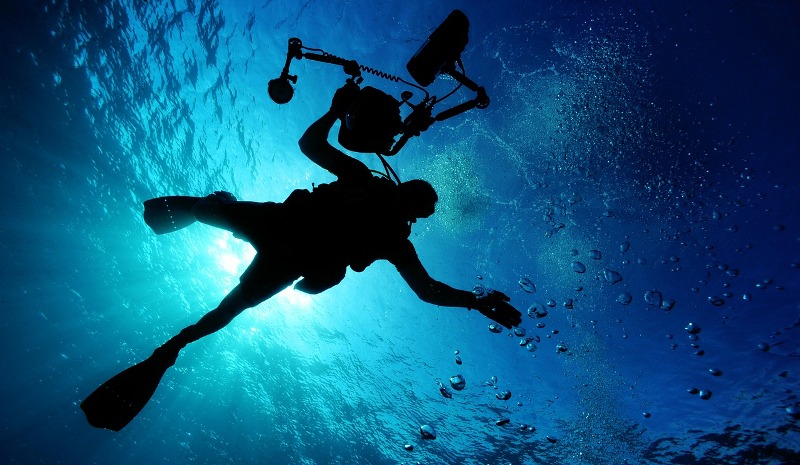
    deep underwater scuba diving
    Photo by Jeremy Bishop

    Lets examine, how deep is the deepest spot of ocean is. The Mariana Trench or Marianas Trench is the deepest part of the world’s oceans. It reaches a maximum-known depth of 11,034 metres (36,201 ft). Just to give you scale of measure, if you drop Mount Everest in Mariana Trench, its peak still be 1.6 Km underwater.

    At bottom of the Mariana Trench the pressure is 1,086 bars (15,750 psi), more than 1,000 times the standard atmospheric pressure at sea level.

    Does life exist at such a high pressure area ? Yes.  In 1960 an expedition have found out that large creatures living at the bottom, such as a flatfish about 30 cm (12 in) long, and shrimp.

    However, the Professional Association of Diving Instructors (PADI) defines anything from 18 metres (60 ft) to 30 metres (100 ft) as a “deep dive” in the context of recreational diving (other diving organisations vary), and considers deep diving a form of technical diving.

    In technical diving, a depth below about 60 metres (200 ft) where hypoxic breathing gas becomes necessary to avoid oxygen toxicity may be considered a “deep dive”.

    Human without any vessel can go upto 1090.4 ft deep. If you wondering of going more deeper than this. Let us make you aware that this is a Guinness World Records set by Ahmed Gabr who did scuba diving upto 1090.4 ft deep in red sea in Egypt. That’s humans limit in water, till now.

    And if you are in submersible vessel like Deepsea Challenger, then you can go as deep a Mariana Trench.

    You must read this Mariana Trench, the deepest spot of the Earth’s Ocean


    Credits :

    The National Ocean Service

    wikipedia.org