Ask someone which companies are driving AI and you will probably hear Nvidia or Google. Fair enough. But follow the hardware a little further back and you arrive in Veldhoven, a town in the Netherlands.
This is where ASML is headquartered. You cannot download its latest machine, and you certainly will not find one sitting on a normal desk. Yet its equipment helps make the advanced chips that keep the AI race moving.
It makes the machines that make the chips
Founded in 1984, ASML builds lithography systems. Chip manufacturers use these machines to print incredibly small circuit patterns onto silicon wafers.
Think of the difference between designing a book, printing it and building the printing press. Nvidia designs chips. Foundries such as TSMC manufacture them. ASML supplies a crucial part of the manufacturing equipment. Different jobs, all connected.
A very unusual kind of printing
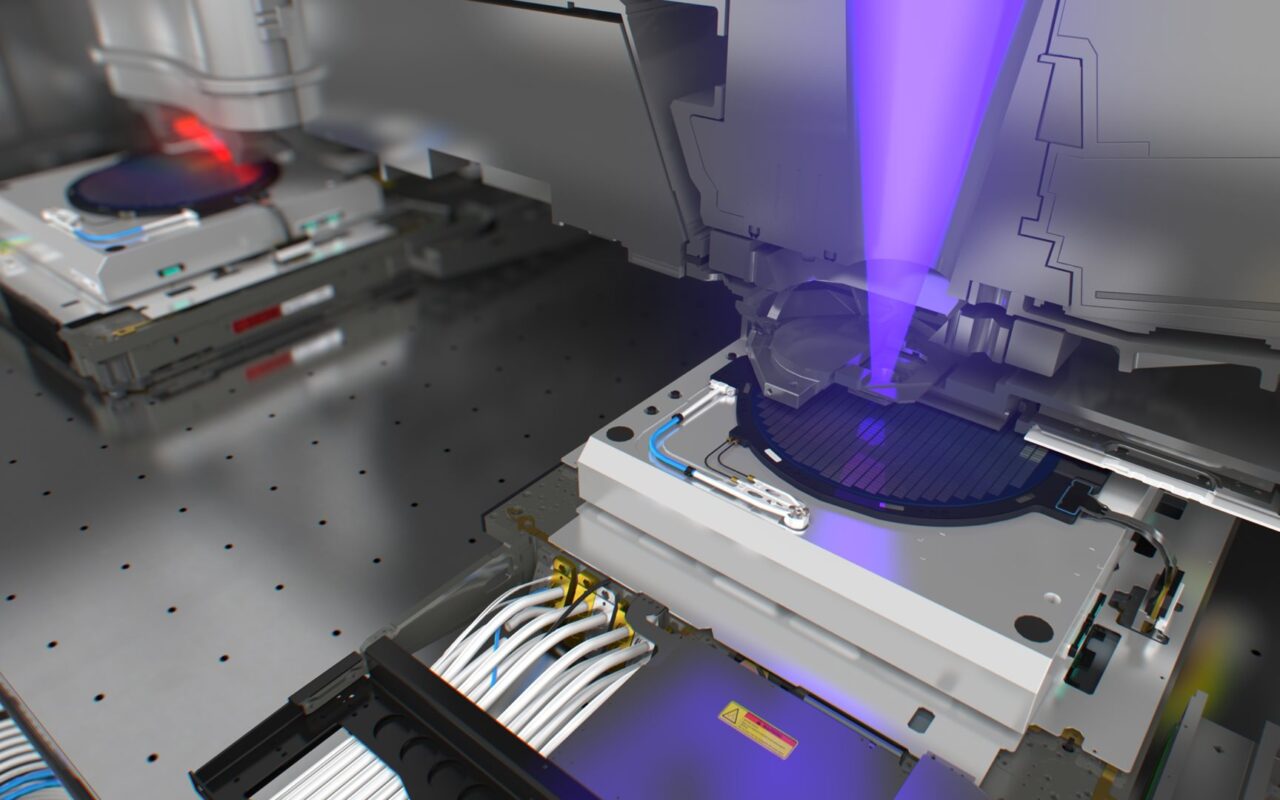
A wafer is a thin silicon disc on which many chips are built together. In lithography, light transfers a pattern from a mask onto a light-sensitive coating on the wafer. Precision optics shrink and focus that pattern.
Other manufacturing steps add materials, develop the coating and etch structures. The sequence repeats to build the chip layer by layer. Once finished, the wafer is cut into individual chips for packaging.
Sounds tidy when written in three sentences. Doing it repeatedly, with tiny features lining up correctly, is a rather different challenge.

Then things get a little wild
ASML’s EUV machines use extreme ultraviolet light with a wavelength of just 13.5 nanometres. To generate it, lasers hit tiny droplets of molten tin, creating a plasma that emits the required light.
Yes, molten tin and lasers. Behind that friendly chatbot is some fairly dramatic physics.
ASML’s explanation of its light sources shows why shorter wavelengths matter: they help the machine print smaller features. Special optics, precise movement and careful measurement all have to work together.
See ASML’s High NA EUV machine
So where does AI fit in?
AI needs chips that can do enormous amounts of computing. Manufacturing those chips depends on turning complicated designs into working hardware at scale. That is where ASML’s precision becomes useful.
The connection is becoming more demanding, too. In a September 2026 announcement with ASML, TSMC said increasingly complex transistor designs for AI would drive greater use of High NA EUV, the next generation of this technology. The companies are also working towards larger photomasks to improve productivity.
Of course, a lithography machine does not build an AI system by itself. Chip design, memory, packaging, software and the rest of the factory still matter. ASML occupies one very difficult part of that much larger effort.
And that is what makes the company interesting. While the world watches what AI can do on a screen, engineers in the Netherlands are helping make the tiny structures that let it happen at all.