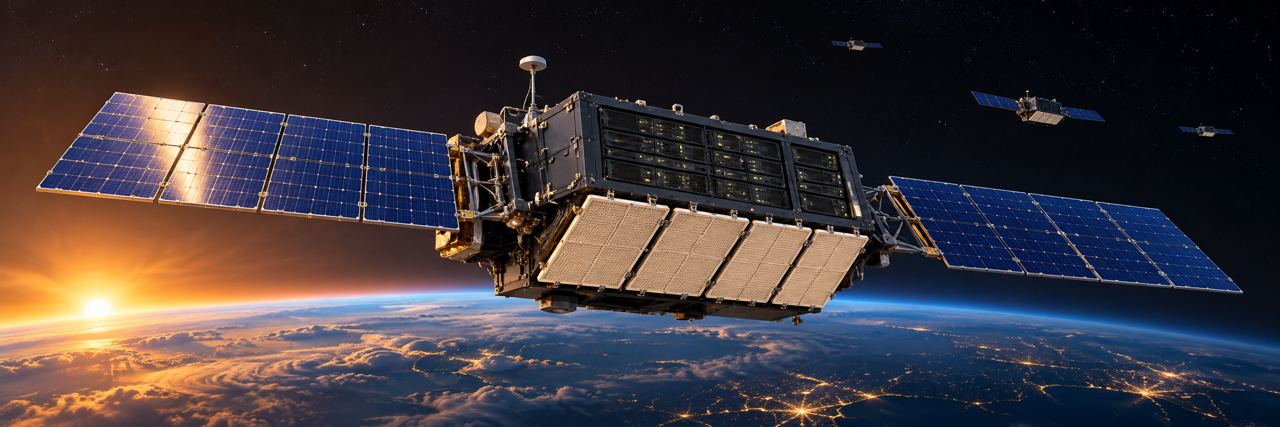
On November 25, the US Federal Communications Commission gave SpaceX conditional approval to put up to a million computing satellites in orbit. Elon Musk’s company calls the proposed network Starmind. The first deadline in the licence is rather more modest. By November 25, 2033, SpaceX has to get one of them into its assigned orbit and working.
What would that satellite actually do? Imagine sending a job to a data centre. With Starmind, the chips doing the maths could be passing overhead while you wait for the result back on Earth. SpaceX wants to use sunlight to power those chips. The tricky bit comes after the electricity reaches them.
SpaceX Starmind has a heat problem to solve
Put your hand near the vent of a busy laptop and you can feel where some of its electricity went. Multiply that by racks of AI processors and cooling becomes a job in its own right. It’s one reason data centres can be so noisy.
Space sounds like a fine place to cool a computer. But try blowing a fan across a hot chip in a vacuum. There’s no surrounding air to carry the heat away. A spacecraft has to move that heat to a radiator and let it escape as infrared radiation. Bigger computing loads mean more heat to shed, and every extra panel has to fit on a rocket.
Sunlight is still an attraction. Solar panels in orbit can collect energy above the clouds, and the computers draw on that power where it’s generated. The trade is in the hardware. A technician on Earth can walk down an aisle and swap a failed board. SpaceX has to price in what happens when that board is circling the planet.
From one satellite to 100,000
The FCC timetable gives a sense of the manufacturing job ahead. After the first spacecraft, the next milestone is 100,000 operating satellites by November 2035. The full million is the authorised ceiling, with a deployment deadline in November 2040. Those dates are licence conditions. How fast SpaceX can build, launch and connect the machines is a separate question. Read the FCC order.
There’s also the view from below. A satellite catching sunlight can draw a bright streak across a telescope’s long exposure. Astronomers often need those exposures to pick out objects far too faint to see by eye. The American Astronomical Society has raised concerns over what a constellation this large could mean for observations from the ground. See the society’s response.
For now, the spacecraft worth watching is number one. If it can run a useful AI workload, stay cool and send the answer home, we’ll have a much better idea of what SpaceX gets for the price of a launch.